
Each Hyperedition is based on a main XML-TEI file, compliant with the TEI P5 Guidelines and validated against the tei_all schema. The Text Encoding Initiative is the reference standard for representing texts in the humanities: choosing it means making the data readable by other systems, verifiable and preservable over time. The main file holds three levels together: the structure of the text, the entities and references that run through it, and the resources that accompany it.
The structure
Pages, acts, speeches and stage directions.
Entities and references
Characters, places, vocabulary and notes, linked to their entries.
The resources
Audio, video, images and letters, anchored to the page.
The header (teiHeader)
The header describes the work and the work done on it:
titleStmtwith the responsibilities (respStmt): coordination, encoding, sponsorship by the Commission for the National Edition, curation by CINUM;editionStmtandpublicationStmt, with the University of Catania – CINUM as the responsible body;sourceDesc, with the bibliographic reference to the first edition and the critical edition and, for manuscripts, the physical description inmsDesc(shelfmark, support, number and size of the leaves, foliation, history of the document);revisionDesc, which records inchangethe stages of the encoding, with date and person responsible.
The structure of the text
- Pages:
pb n="…"marks the beginning of each page of the printed edition. It is the link between the digital text and the book, and the key with which the interface scrolls the text and calls up the resources. - Divisions:
div type="title",div type="castList"anddiv type="atto" n="…"for the plays; chapters for the novels;headfor titles. - Dramatis personae:
castList,castItemandcastGroup(for example «I quattro finti Consiglieri Segreti»), each linked with@sameAsto the character's entry. - Speeches and stage directions: each speech is an
spwith the name inspeakerand the text inp; stage directions arestage, with italics inhi rend="italic".
Who speaks to whom
Each speech declares the speaker (@who) and the addressee (@toWhom). It is the most distinctive choice of the model: describing the interlocutors of each exchange makes it possible to query the text by character, to combine the encoding data with the lemmatisation data and to obtain, for example, all the occurrences of a lemma spoken by Enrico IV, or the selective vocabulary of a single character.
Entities and commentary: the text that refers
In the text we mark the mentions and link them, through an identifier, to the corresponding entry gathered at the end of the file (back). The text stays clean; the information lives in one place only and is called up wherever it is needed.
| In the text | Refers to (in back) | What the entry contains |
|---|---|---|
persName ref="#…" | listPerson / person | Name, description of the character or historical figure, link to Treccani |
rs ref="#…" | person | Indirect reference to a character (for example «dottore» for Genoni) |
placeName ref="#…" | listPlace / place | Name, coordinates in location/geo, note, link to OpenStreetMap |
orgName, objectName | listOrg / org; dedicated entry | Institutions (the Court of France), works of art and objects (Sirio's «Diana») |
term ref="#…" | list type="term" / item | Lemma (term), definition (gloss), reference dictionary (ref) |
ptr type="bibl" ana="#n_…", seg type="note" | list type="note" / list type="bibl" | Commentary notes: title (label) and text (note) |
Resources anchored to the page
At the beginning of each page a note type="media" place="block" block gathers the relevant resources, each as an anchor whose @source points to the entry in the list type="media" catalogue. Each entry has a title, a short description (desc) and a media element with the file type (@mimeType) and address (@url). The same resource (the letter to Ruggero Ruggeri, an audiobook) can thus be called up from several pages without duplication.
<pb n="3"/>
<note type="media" place="block">
  <anchor xml:id="p3_AudiolibroScena1" source="#enricoIV-AudiolibroScena1"/>
</note>
<sp who="#Landolfo" toWhom="#Bertoldo">
  <speaker><persName ref="#Landolfo">LANDOLFO</persName></speaker>
  <stage><hi rend="italic">(a <persName ref="#Bertoldo">Bertoldo</persName> come seguitando una spiegazione)</hi></stage>
  <p>E questa è la sala del trono! <ptr type="bibl" ana="#n_saladeltrono"/></p>
</sp>
<sp who="#Arialdo" toWhom="#Landolfo">
  <speaker><persName ref="#Arialdo">ARIALDO</persName></speaker>
  <p>A <placeName ref="#Goslar">Goslar</placeName>!</p>
</sp>
The manuscript
The manuscript editions are encoded in separate XML-TEI files and displayed with EVT 1 (Edition Visualization Technology), in a version adapted to the project. Each leaf opens with a pb whose identifier links it to its image (for example MSItal83-6r); the revision work is described as follows:
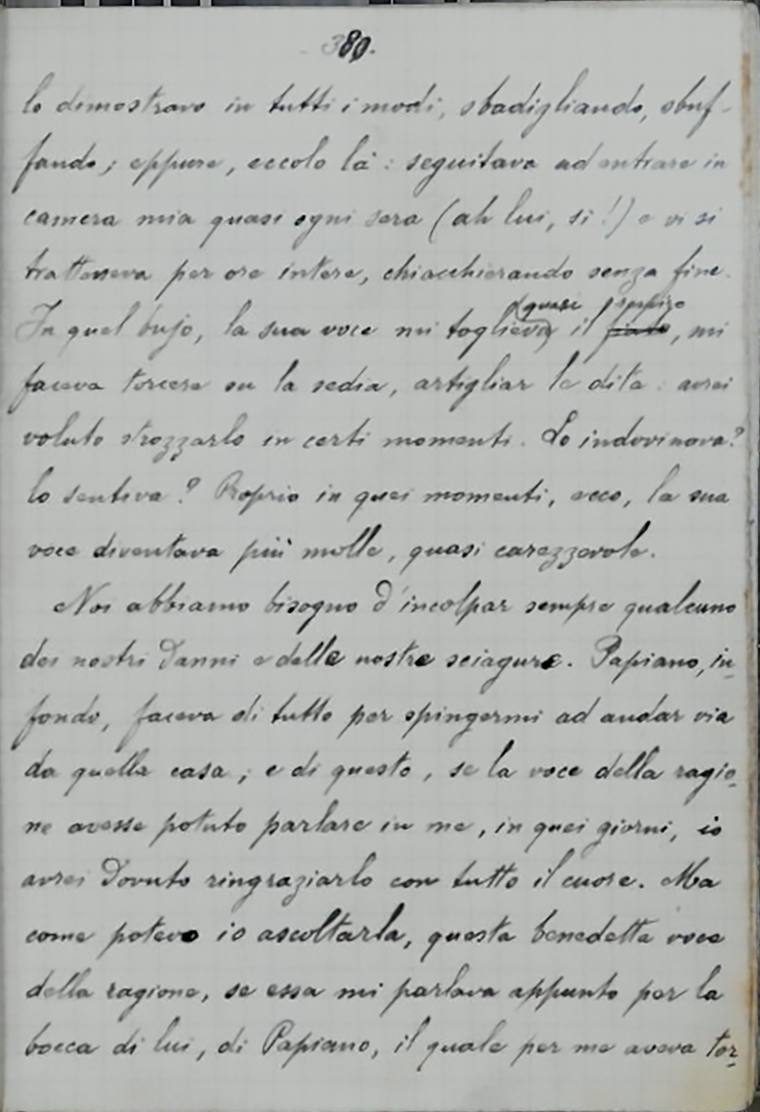
| Feature | Encoding |
|---|---|
| Deletion | del |
| Overwriting | del rend="overwritten" followed by add place="superimposed" |
| Interlinear addition, above or below | add place="above", add place="below" |
| Inline or marginal addition | add place="inline", add place="left" (and similar) |
| Uncertain or illegible reading | unclear reason="illegible" |
| Gap or illegible deleted passage | gap reason="illegible" / gap reason="deletion", with @unit and @quantity |
| Editorial supplement | supplied |
- deletions in Il fu Mattia Pascal, 573 leaves
- 832
- additions in Il fu Mattia Pascal
- 740
- deletions in Enrico IV
- 656
- additions in Enrico IV
- 770
The apparatus
The dynamic edition of Il fu Mattia Pascal, edited by Giuseppe Canzoneri, represents the apparatus with the Parallel Segmentation Method of the TEI Guidelines: each variant location is an app, with the adopted reading in lem and those of the other witnesses in rdg, each attributed to its witness. The file is displayed with EVT 2, which shows up to three witnesses side by side and opens the apparatus on each variant.
The Hypereditions in figures
Data taken from the XML-TEI files of the three theatre Hypereditions (October–November 2025 versions).
| Work | Pages | Speeches (sp) | Character mentions | Place mentions | Glossary entries | Commentary notes | Multimedia resources |
|---|---|---|---|---|---|---|---|
| Enrico IV | 88 | 918 | 1,317 | 30 | 40 | 27 | 26 |
| La vita che ti diedi | 41 | 657 | 740 | 9 | 16 | 19 | 17 |
| Diana e la Tuda | 56 | 1,153 | 1,234 | 11 | 28 | 16 | 14 |