
The reference text
The Hyperedition does not establish a new text: it encodes and links the text established by the editors of the National Edition and published by Mondadori. Every intervention on the text is therefore the responsibility of the critical edition, which remains the scholarly reference; the task of the Hyperedition is to make it readable, searchable and verifiable.
The page as the unit of reading and citation
The page numbering of the Hyperedition matches that of the printed reference edition. The page is the unit through which the text is browsed, to which the resources are anchored and by which it is cited: Il fu Mattia Pascal has 237 pages (following the numbering of the critical edition edited by Miryam Grasso), Enrico IV 88, La vita che ti diedi 41, Diana e la Tuda 56.
Within the page the text keeps its own logical structure: chapters for the novels; title page, list of characters, acts, speeches and stage directions for the plays.
Transcription and checking of the text
- The text faithfully reproduces the reference edition, without spelling normalisation: forms such as sdrajati, jeri, maraviglioso are kept.
- The italics of the stage directions and the capitalised character names before each speech are kept, as in print.
- Each text was collated against the printed edition by a checking team, named in the credits of each work.
The manuscripts
We use the text-and-image edition only for autograph witnesses that matter for the transmission of the text, which in Pirandello's case are not the majority.
- Il fu Mattia Pascal: notebook MS Ital. 83 of the Houghton Library (Cambridge, Mass.), the antigraph of the novel, a kind of manuscrit du copiste in which Pirandello copies himself. We follow a progressive numbering of the leaves (from 1r to 573r) that compensates for double pages and gaps in the author's numbering.
- Enrico IV: a manuscript carrying a version very close to the princeps, with many currenti calamo and interlinear corrections, and fragments of the three acts that point to an earlier version which cannot be fully reconstructed.
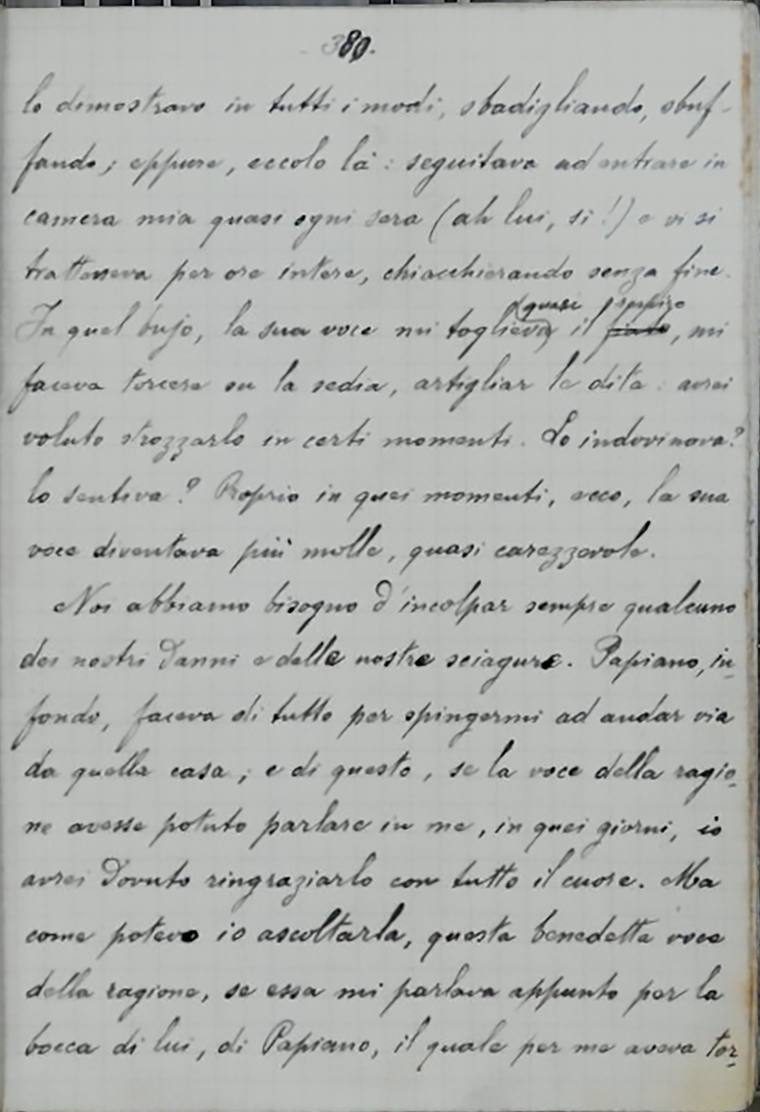
The transcription is diplomatic, leaf by leaf, and records every feature of the revision process: deletions, overwritings, additions (interlinear above or below, inline, in the margin), illegible passages, gaps and editorial supplements. We avoid hyper-diplomatic temptations: the aim is to make the revision work readable. Where deletions cover the text, digital restoration of the images made transcription possible.
For each page of the printed text we give the corresponding leaves, with the first and last line: for example, p. 4 of Il fu Mattia Pascal begins at line 11 of f. 6r and ends at line 6 of f. 9r.
Apparatus and variants
Pirandello's works have an essentially printed tradition, with an imposing body of variants: rewritings affecting language and style, with semantic consequences, and recurring serial variants (for example the shift from the single to the double consonant form of articulated prepositions). A crowded traditional apparatus risks losing touch with the text.
This is why we offer two complementary modes:
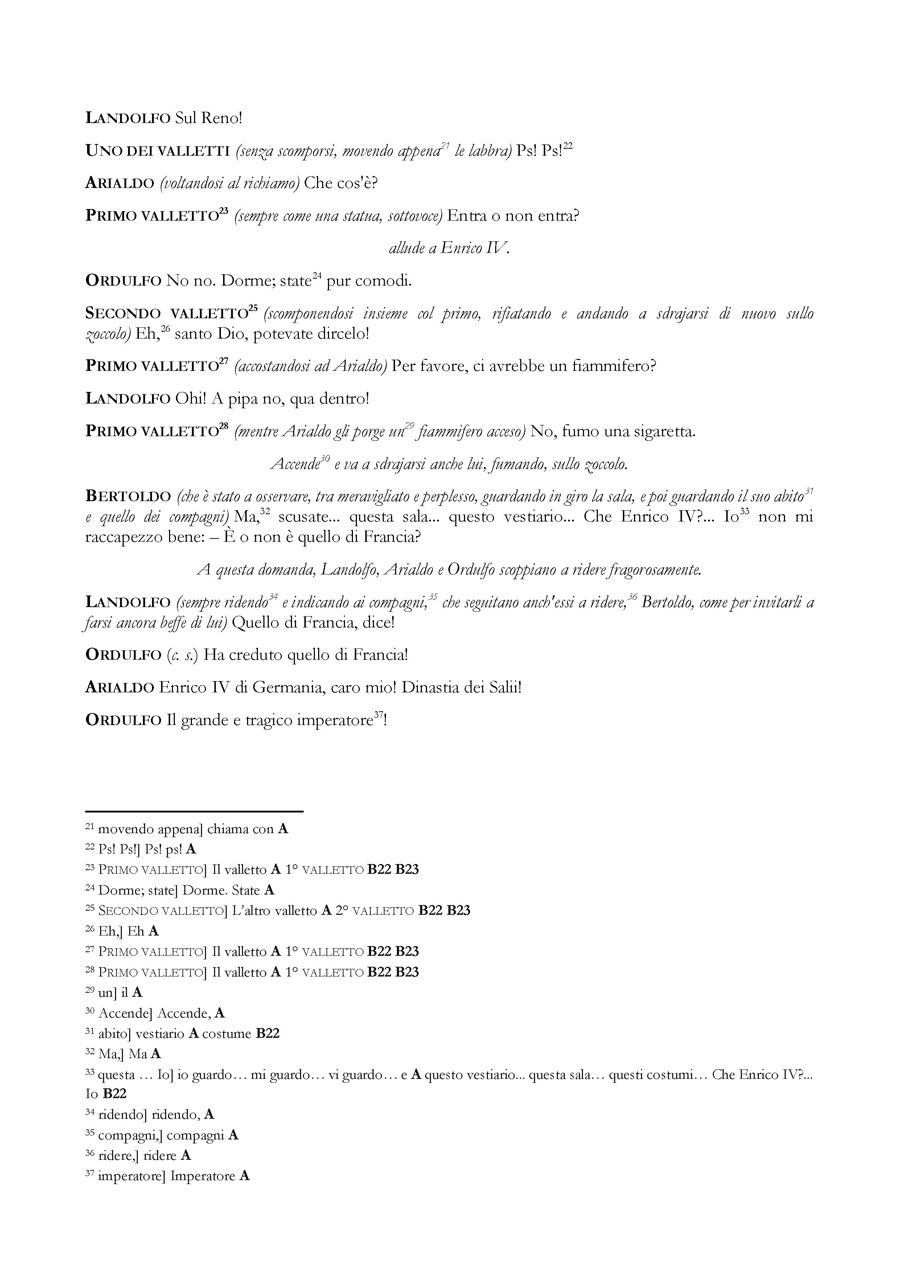
- Static edition: the pages of the printed critical edition, with the apparatus at the foot of the page, for those who prefer the familiar form.
- Dynamic edition: the collation of the printed witnesses encoded in XML-TEI and displayed synoptically, with up to three witnesses side by side and a pop-up apparatus for each variant. The portal's «Edizioni a confronto» (Editions compared) section, produced by automatic collation (first with Juxta, then with Variance Viewer, extended to more than two texts), highlights the passages with variants.
The commentary
The commentary is designed for a wide audience and is anchored to the point of the text it refers to. It includes:
- commentary notes: synopses of the acts, plot, thematic cores, philological and lexicographical notes (for example evidenza, which in Enrico IV replaces the manuscript's appariscenza);
- glossary: obsolete, regional or difficult words, each with a short definition and a reference to the dictionary used (De Mauro, GDLI, Treccani, Sabatini Coletti);
- characters: an entry for every character, even those only mentioned, and for historical and mythological figures;
- places and institutions: an entry with geolocation on OpenStreetMap and, where useful, a link to the Treccani Encyclopaedia.
For external sources we favour open and stable resources.
Multimedia resources
Each page can be linked to resources that accompany the reading: audiobooks and actors' readings, scenes from films and stage productions, Pirandello's letters, image galleries, teaching units and data visualisations. The resources are hosted by the portal or linked to their original source; the images published are in the public domain.