
The Hyper-interface, designed specifically for pirandellonazionale.it, is the gateway to all the resources of a work. It is based on a two-window model: on the left the text, always visible, one page at a time following the numbering of the printed edition; on the right the tool chosen by the reader, synchronised with the page being read.
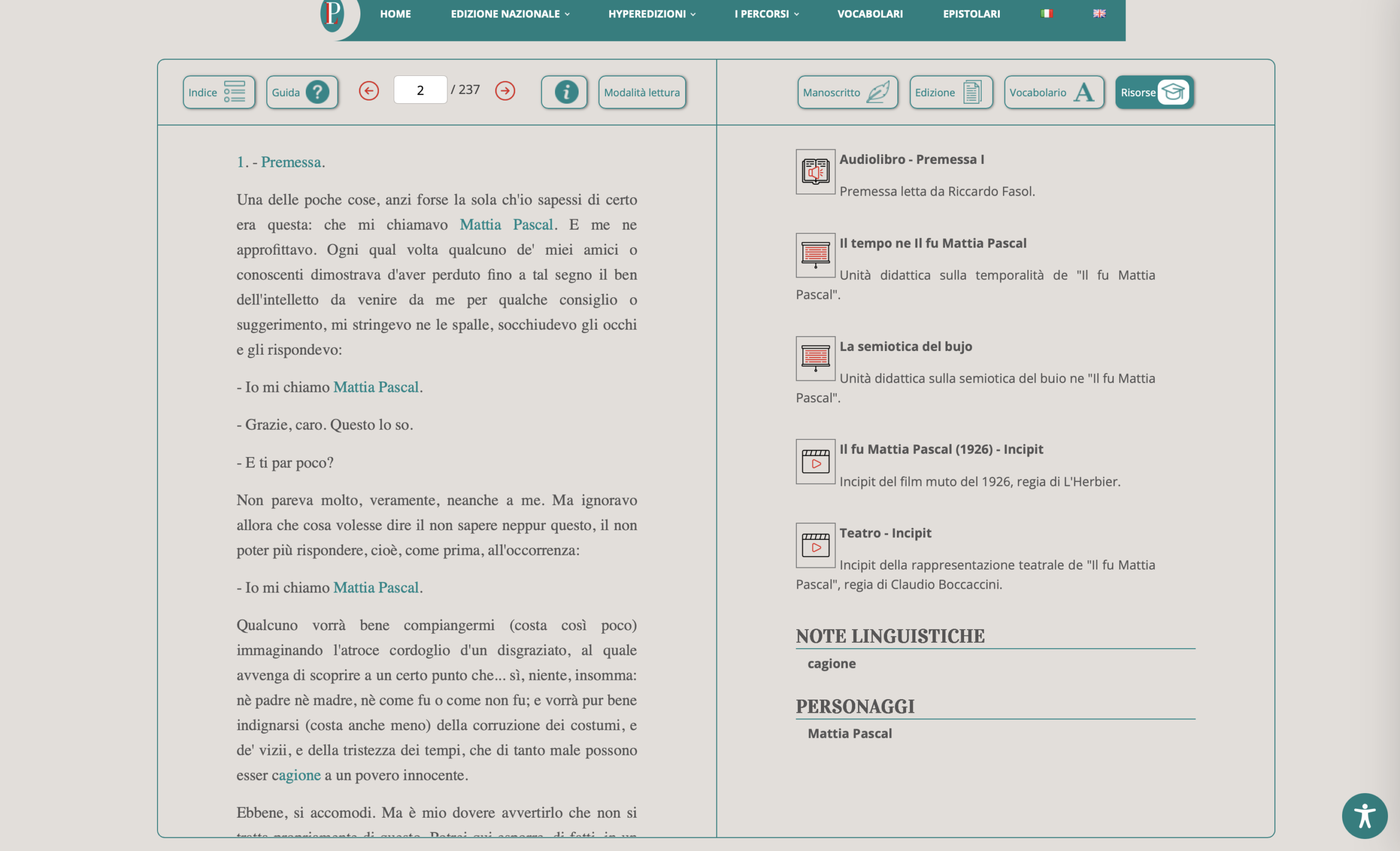
The four paths
Manuscript
- MS edition
- The diplomatic edition of the manuscript in EVT 1, with the images of the leaves next to the transcription.
- Visualisation
- The leaves corresponding to the page being read, with the first and last line indicated; a click opens the leaf full screen.
- Restoration
- A sample of the digital restoration process, comparing the original leaves, the deletions and the restored version.
Edition
- Critical
- The pages of the printed critical edition, with the apparatus of variants.
- Digital
- The edition encoded in XML-TEI and displayed in EVT 2, with the witnesses side by side; for the plays, the «Edizioni a confronto» (Editions compared), act by act.
Vocabulary
A search by word form or by lemma in the concordance of the work or of the whole corpus. With the vocabulary active, every word of the text can be queried: a click returns absolute frequency, relative frequency and contexts of use (KWIC, Key Word in Context).
Resources
A page-by-page list of everything linked to the text: commentary notes, glossary, entries on characters and places, audiobooks, scenes from films and stage productions, letters, teaching materials.
The orientation tools
Contents
The divisions of the work (chapters, list of characters, acts), with their first and last pages.
Go to page
A direct jump to a page of the edition.
Reading mode
The text full screen on two facing pages; annotated words are highlighted and the commentary opens in a pop-up window.
Guide, and Information and responsibilities
The instructions for use and the credits of the work.
Technical choices
The interface is developed in JavaScript as a component of the site and is:
Dynamic
It returns data by querying the XML files and the concordance database.
Asynchronous
It lets you keep reading while content is loading.
Responsive
It adapts to the screen and the device in use.
Each Hyperedition is described by a configuration file that states where to find the cover, contents, credits, text, pages, manuscript, editions, vocabulary and resources. Adding a work therefore means preparing its data according to the model, not rewriting the interface: this is what made it possible to move from the pilot edition of Il fu Mattia Pascal to the Hypereditions of the rest of Pirandello's corpus.