
Each Hyperedition starts from one main XML-TEI file per work, from which the text and resources the reader finds in the interface are derived; the manuscript, the collation and the concordance have their own data, linked to the same pagination. Repeating the same stages work by work has made the model replicable.
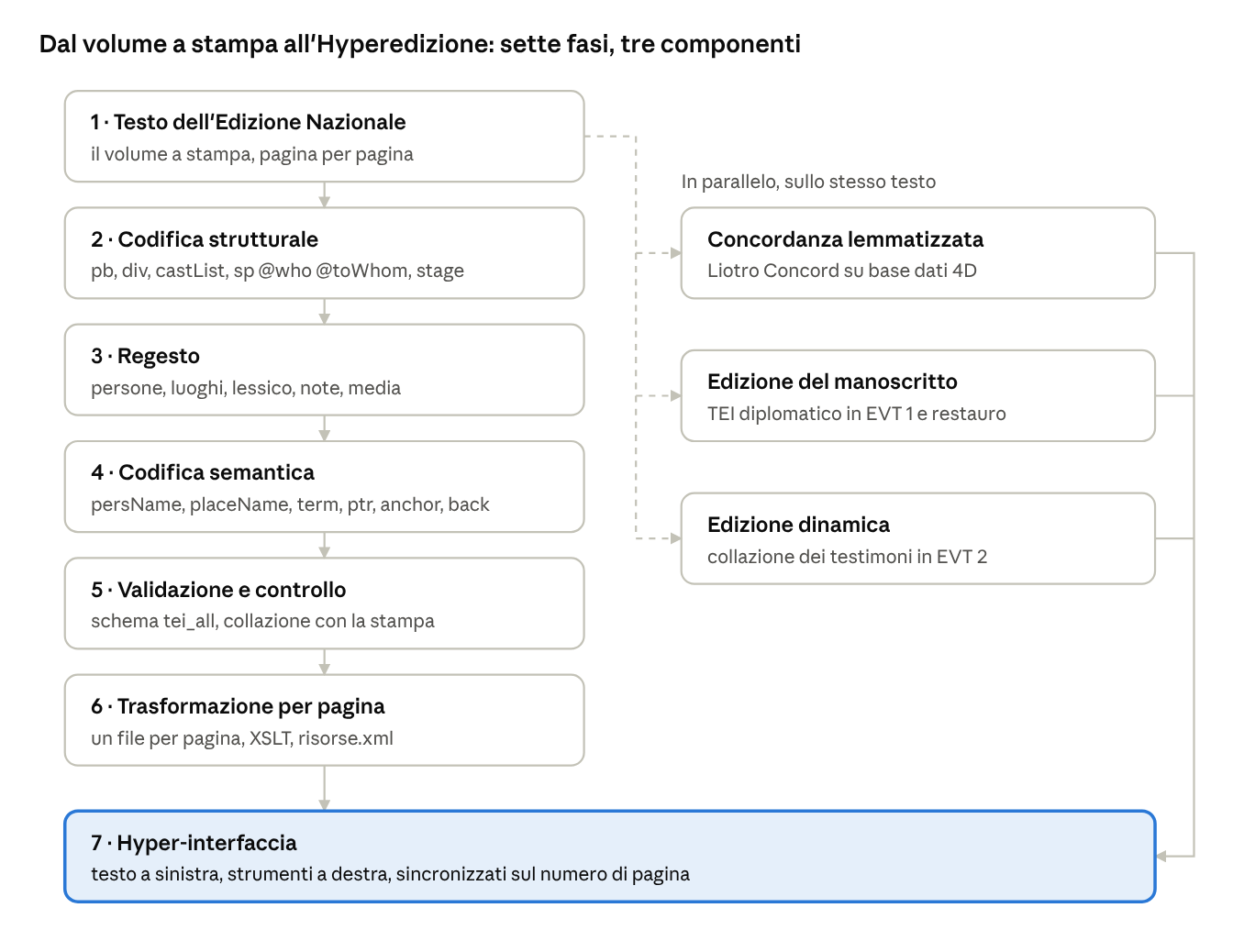
The left-hand column is the main chain; on the right are the components that work on the same text and flow into the interface.
The seven stages
- The reference text. We start from the text established in the National Edition, with the pagination of the printed volume.
- Structural encoding. We mark pages, divisions, the list of characters, speeches (with speaker and addressee) and stage directions.
- The register. In a shared worksheet the researchers collect, for each work, the entries for characters, places (with coordinates), institutions, objects, glossary entries, commentary notes and multimedia resources, giving for each one the page, the external source and the person responsible.
- Semantic encoding. The register becomes the final part of the TEI file (
back); in the text we mark the mentions and the references to the entries, and anchor the resources to the page. - Validation and checking. The file is validated against the TEI schema and collated against the printed edition by a checking team; revisions are recorded in the header.
- Page-by-page transformation. The text is split into units corresponding to the pages of the edition; XSLT stylesheets generate an HTML page for each, which keeps the references to the entries, and a page-by-page index of the resources.
- Publication. A configuration file, the index of divisions and the credits sheet connect the data to the Hyper-interface.
Three parallel components
The concordance
The text is lemmatised with Liotro Concord, the software developed by Pietro Sichera for CINUM on a 4D relational database, following Giuseppe Savoca's concordance model: each word is associated with a lemma, with its part of speech and the distinction of homographs. The automatic output is revised word by word by the editors, and each paragraph is associated with the page of the edition.
The manuscript
The leaves are transcribed and encoded in a dedicated TEI file, published with EVT 1; the images with the most extensive deletions undergo digital restoration (pixel sampling, image processing, reconstruction of the passage).
The dynamic edition
The collation of the printed witnesses is encoded with the parallel segmentation method and published with EVT 2.
The next step
The next step is to join the encoding data with the lemmatisation data: linking each occurrence both to its lemma and to the character who speaks it will make it possible to build selective vocabularies for each character.